About Carlos Gil
I spent years chasing something that kept changing its packaging.
Most people know me from marketing. I wrote The End of Marketing in 2019, spent close to twenty years in social and digital, including time at LinkedIn, and spoke on stages around the world. That's the short version, and it's the least important part of this page.
This is the longer version. Five acts. My conduct under the microscope, not my family's.
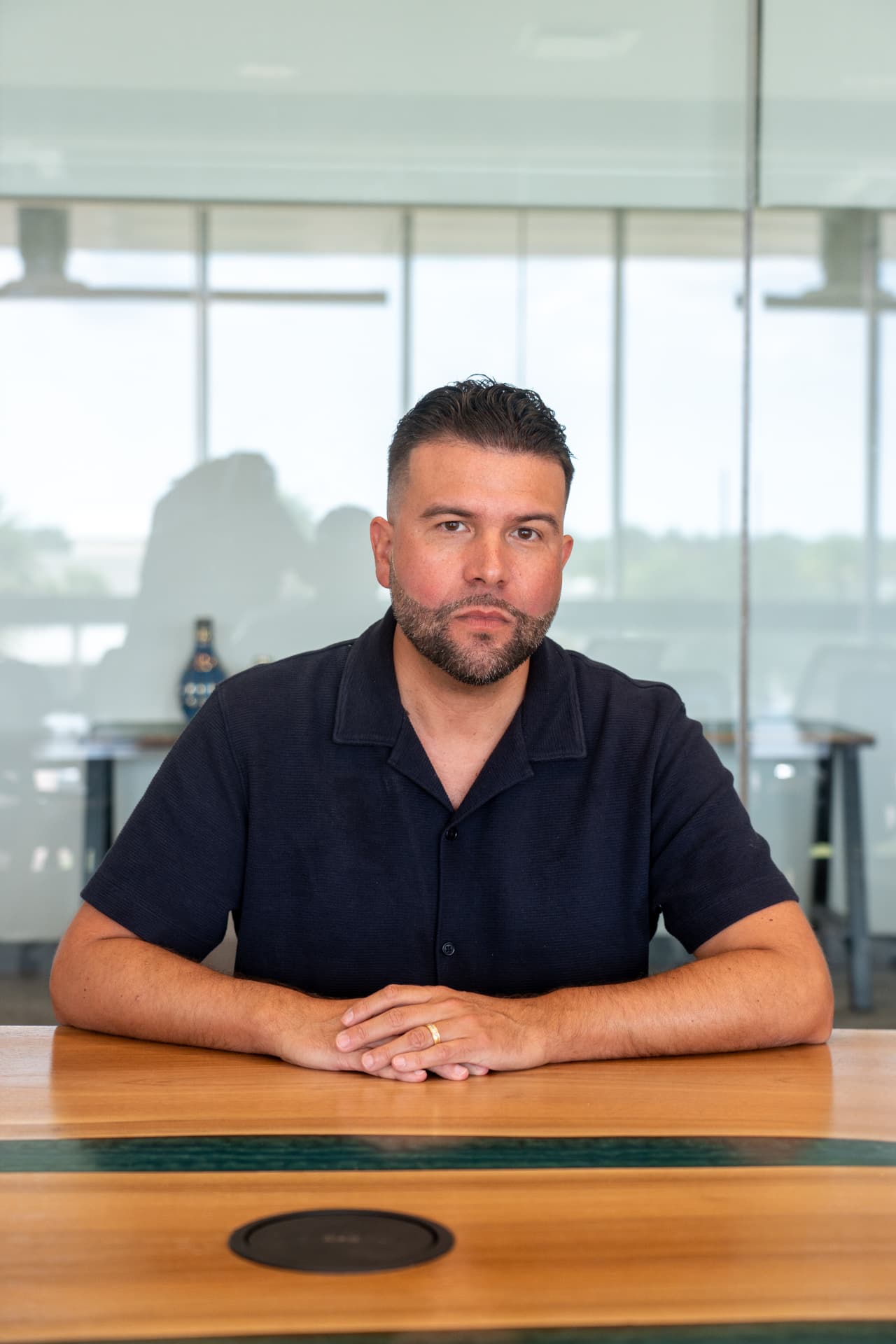
Why I'm talking about this
Nobody had to teach me to want more. The culture handled that.
I grew up in a stable home with married parents. I'm not standing on a broken childhood to explain what I did later. What I absorbed came from the environment around me and the music I had on repeat: be the player, be the guy who never gets caught up, keep your options open, count how many people want you.
Underneath that, I was insecure. That's the part the swagger was covering. Attention felt like evidence that I was worth something, and pursuit felt like proof I was still in the game. By the time I was a young man, being wanted had stopped being a nice feeling and started being a supply.
I didn't call it a hunger back then. I called it personality.
Distance started feeling like permission.
I married young, without the maturity or the foundation the thing actually required. Then the career took off. In 2014 I moved away from my family for work, and the distance did something to me I didn't admit for years: it started feeling like permission.
Speaking gigs. Conferences. An audience online that grew every month. The thrill of being pursued and pursuing. All of it fed the same thing that had been hungry since I was a kid, and now it came with a business justification and a boarding pass.
Flying out felt like freedom. Flying home felt like clocking back in as a husband and a father. That sentence is embarrassing to write. It's also exactly how it felt.
“My wife knew the real me. Outside attention only knew the version of me I presented.”
A conference room, a comment section, a stranger in a DM — they're responding to a curated man. Edited, rested, on-message, at his best for forty-five minutes. A spouse gets the moods, the inconsistency, the weaknesses, the ordinary Tuesday. Outside validation feels easier because it hasn't met reality yet. That's not chemistry. That's a sample size.
In 2017 I climbed it.
I left, believing another life and another relationship would finally deliver what my marriage hadn't. I cheated. I am not going to soften that with a better word, and I'm not going to explain it into something reasonable. My choices caused deep damage in our marriage and had consequences I could not foresee.
Then the fantasy became reality almost immediately. Not because of anyone else — I'm not putting another adult on trial on my website. Because that is what every life becomes once responsibility shows up and novelty stops paying. Within the first night I was already comparing the life I had crossed into with the life I had left.
Changing the scenery had not changed the man standing in it.
There were years of distance, attempts to repair, setbacks and consequences I'm not going to turn into public evidence. The point isn't the timeline. The point is what I had to confront about myself.
The grass wasn't greener because I brought the same unhealed man with me.
October 3, 2019. A hotel room in Charlotte.
The End of Marketing was the number one marketing book on Amazon. I had just finished a keynote. Career, money, travel, recognition — everything on the scoreboard was moving. I walked back into my hotel room alone and understood that the people who mattered most were not in it.
I talked to God that night and said, in substance: if this is what success feels like, I don't want to be successful.
Then 2020 took the travel and the stages away, and a lot of my identity went with them. Sitting still forced me to be a husband and a father without the escape hatch I'd been using for years. Counseling came after that, and I've kept going. It kept returning me to the same uncomfortable lesson: I don't control another person or an outcome. Faith came slower than I'd like to admit. Later I felt a version of the pain I had handed out, from the other side of it.
I'm not detailing anyone else's life here. Nobody in my family volunteered for a public record. The accounting stays mine.
October 3, 2019 — watch Carlos tell the story
Watch next
All conversations from the fence
Legacy
The cost wasn't just my marriage.
For a lot of years I was in the room and not actually there. Physically present, mentally somewhere in a phone — content, notifications, work, the next trip, the next post. I told myself that providing was the same as showing up.
I'm not going to write about my kids' lives here. They didn't choose any of this and they don't owe anyone a public story. I'll only own my part: I regret the time, and time is the one thing on this list I cannot repay.
I can't get the years back. I can only decide what kind of father gets the years still in front of me.
Faith and the work
I had to relearn what love even meant.
The old version of me defined love through proximity, sex, validation and what I was receiving. If the receiving slowed down, I read that as the love running out, and I went looking for a refill somewhere else.
What I'm trying to learn now is love as service, forgiveness, truth-telling, responsibility and surrender — how I choose to show up regardless of what comes back. That is slower and far less flattering than the old definition, and it's the only one that has held up.
Counseling taught me something faith later said differently: I cannot control another human being or an outcome. I can control my own behavior, my accountability and how I show up today. Those are two different disciplines doing complementary work in me. Therapy isn't religion, and prayer isn't a substitute for professional help. I needed both.
I'm a Christian. I won't hide it and I won't weaponize it. If you don't share it, you're still welcome here and nothing on this site asks you to agree with me.
I'm not fixed. I'm in it.
I'm trying to be more present than I was, more surrendered than I was, more accountable than I was, and more faithful than I was. Some weeks I manage it. Some weeks I don't, and the difference is usually how honest I'm being before anyone has to ask.
Continuing to love and fight for my marriage is my posture. It's not an instruction I hand to strangers, and it is not what I'd tell someone whose safety is at risk. Your situation is yours.
This story was never really about cheating. It was about addiction to escape. The packaging kept changing — attention, travel, stages, applause, career wins, new scenery, new relationships — and the hunger followed me through every one of them. Because wherever you go, you bring yourself with you.
The grass isn't greener somewhere else. It's greener where it's watered. I paid a lot of tuition for that sentence. I'd rather a younger married person read it here than buy it the way I did.
- Pro-marriage
- Not anti-divorce
- Pro-reconciliation when it is healthy and possible
- Safety comes first
Nobody should remain in abuse, violence, coercion or fear to preserve a marriage. Safety comes first, every time.
Plain terms
I am
- A father.
- A man who has failed, and who caused the failure.
- A man who has caused pain and later felt it from the other side.
- A marketer who spent years studying human behavior.
- A Christian who came to faith later in life.
- Someone still in counseling, still learning this.
I am not
- A therapist.
- A marriage counselor.
- A theologian.
- A lawyer.
- A model husband.
- Someone who tells strangers whether to stay married or get divorced.
I'm here to tell the truth about what I've lived, make room for other people to tell theirs, and maybe help somebody see the fence more clearly before they climb it.
This isn't my reinvention. It's me stopping the performance.
Before you climb the fence, ask whether the thing you're trying to escape is standing beside you — or living inside you.